
Major Investment Is Being Directed Toward Undersea Cable Security
Undersea fiber-optic cables carry almost all internet traffic moving between continents. Despite their importance, much of this infrastructure remains invisible to the people and businesses that depend on it.
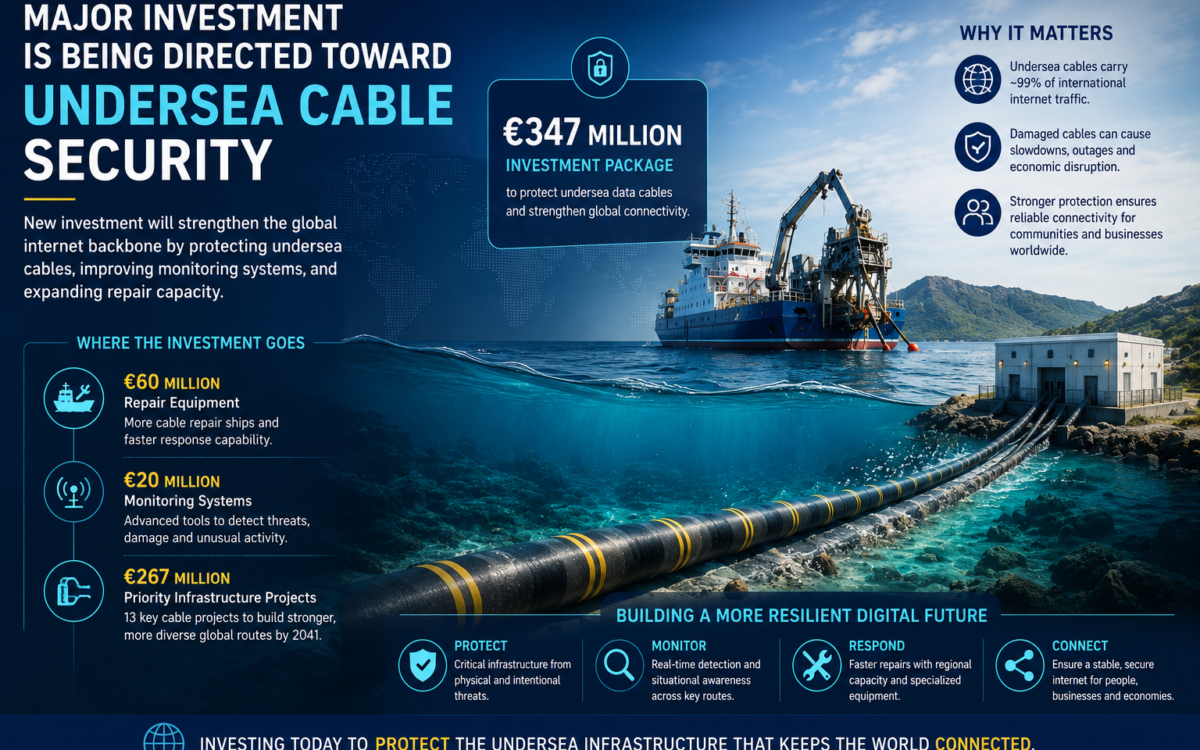
A new infrastructure-security package announced in February 2026 will direct €347 million toward protecting submarine data cables.
The measures include funding for cable construction, monitoring equipment and faster repair capabilities. They also identify 13 priority cable projects that are expected to guide investment over the next 15 years.
Undersea cables can be damaged by ship anchors, fishing activity, earthquakes, underwater landslides, equipment failure or intentional actions.
Most cables are designed with protective layers, but they remain vulnerable. When a cable is damaged, internet traffic can often be redirected through another route. However, this can create congestion, slower connections or temporary service interruptions.
Repairing a cable is a specialized operation. A repair vessel must locate the damaged section, bring the cable to the surface, replace or reconnect the affected part and return it to the seabed.
Weather, water depth and the availability of suitable ships can influence how long repairs take.
Under the new investment program, €60 million will be made available for cable-repair equipment. Another €20 million will support monitoring systems capable of detecting damage and tracking underwater conditions.
An additional €267 million is planned for priority infrastructure projects during 2026 and 2027.
Monitoring technology may include underwater sensors, maritime-traffic information and automated systems that identify unusual activity near important cable routes.
Regional repair equipment will also be positioned closer to high-risk areas. This could reduce response times and prevent damaged cables from remaining out of service for extended periods.
Another important strategy is route diversity. If several cables follow the same path, one incident could affect multiple connections. Creating alternative routes makes the network more resilient.
Undersea cable protection is not only a telecommunications issue. Financial systems, cloud platforms, government communication, healthcare services and international businesses all depend on this infrastructure.
As global data use grows, cable security will become an increasingly important part of economic stability and national resilience.
Tags: #UnderseaCables #InternetInfrastructure #NetworkSecurity #GlobalConnectivity #DigitalResilience #Telecommunications